Why 3D Printing Is the Future of Manufacturing (and Better Than Wax Models)
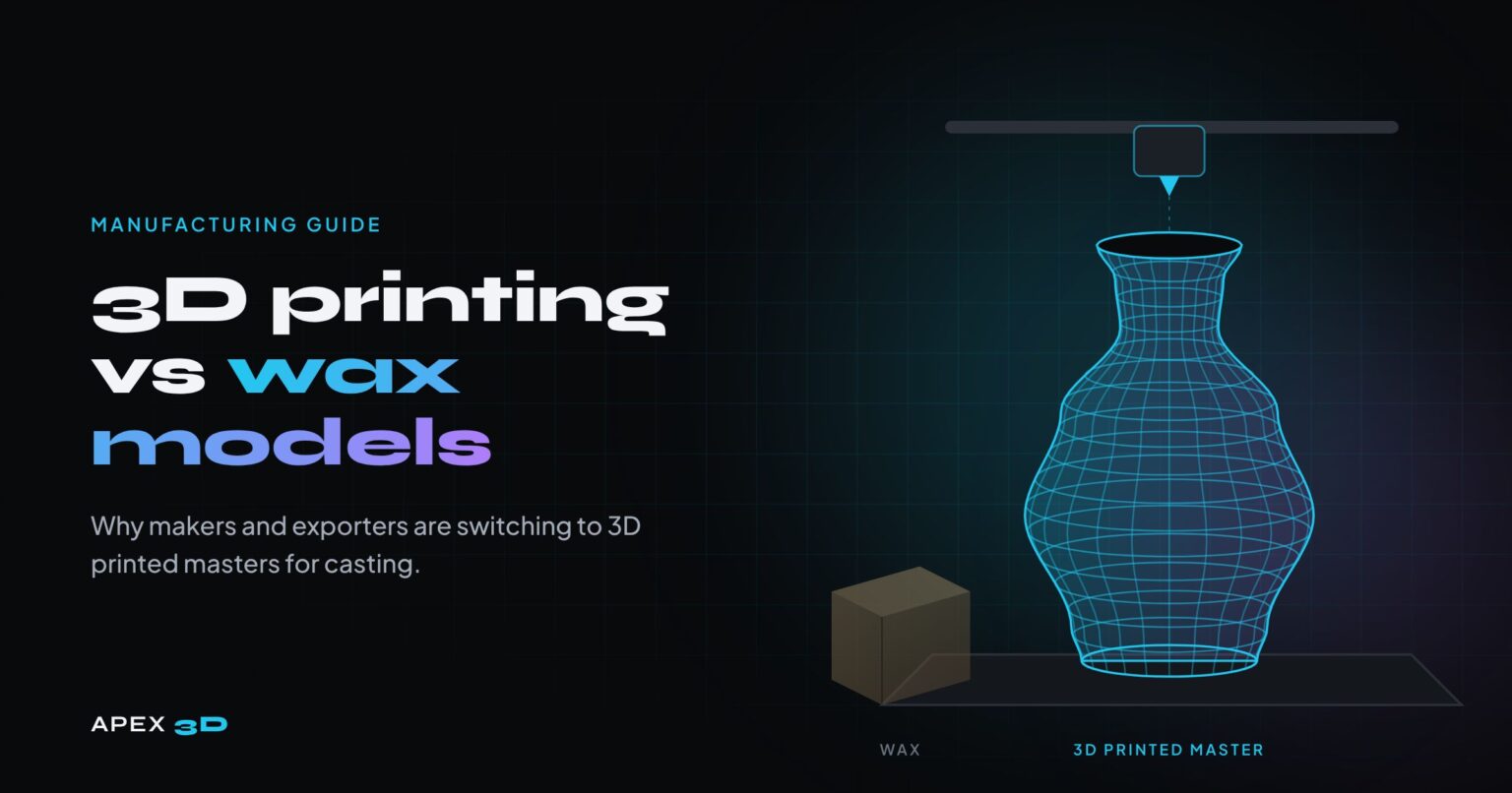
Hand-carved wax models built Moradabad’s metal industry. Here is why makers and exporters are switching to 3D printed masters, and where wax still fits.
Muhammad Faizan
· 11 min read
On this page
- The short answer
- How the traditional wax model route works
- How the 3D printing route works
- Why 3D printing is better than hand-carved wax models
- 1. You approve the design before anything is made
- 2. Changes take minutes, not a re-carve
- 3. Any size from the same file
- 4. Every copy is identical
- 5. Precise, measurable dimensions
- 6. Detail and symmetry that are hard to carve
- 7. Faster samples for buyers
- 8. Your designs are saved forever
- 3D printing vs wax models at a glance
- Common myths about 3D printing for casting
- “3D printing replaces the karigar”
- “Printed masters can’t hold fine detail”
- “It’s only for big factories”
- “My foundry will need new equipment”
- Choosing the right material for a printed master
- What makes a 3D model casting-ready
- Where the savings come from
- Example: one design, three sizes, one logo
- Is 3D printing right for your piece?
- Why it is the future of manufacturing
- Where wax still makes sense
- How to start with 3D for your next piece
For generations, Moradabad’s brass and metal pieces have started life as a model carved by hand in wax. It is a real skill, and it built an industry. But more and more makers and exporters now start with a 3D model on screen and a 3D printed master instead. This guide explains, in plain language, why 3D printing is becoming the new way to make casting masters, how it compares with hand-carved wax, what to watch out for, and where wax still has its place.
Key takeaways
- A 3D printed master comes from a digital file, so you approve the design before anything is made.
- Changes are quick file edits, not a re-carve. One file gives you any size and identical copies.
- Your foundry and mould maker work the same way. Only the master changes.
- A good casting master needs planning: shrinkage allowance, wall thickness, draft and how large parts are split.
- Wax carving still suits free-flowing, one-of-a-kind sculpture. Many workshops use both.
The short answer
A 3D printed master is made from a digital file. That one change brings most of the benefits: you can see and approve the design before anything is made, change it in minutes instead of carving again, make it in any size, and get exactly the same piece every time. Wax carving depends on one person’s hands and time; a 3D file can be printed, resized, improved and sent to a buyer the same day.
Have a wax design you want to move to 3D?
Send a photo of the piece or your sketch on WhatsApp. We will tell you how it can be modelled and printed for your casting method.
How the traditional wax model route works
In lost-wax and similar casting, the first step is a master model. Traditionally a karigar carves it by hand in wax. A mould is taken from that master, wax copies are made from the mould, and the wax copies are used to cast the final metal pieces.
The master decides everything that follows. If its shape, size or detail is off, every casting carries the same mistake. And if the buyer asks for a change, the master usually has to be carved again.

How the 3D printing route works
- Share the idea. A sketch, photo, reference product or old sample is enough. See 3D design and 3D modelling.
- 3D model on screen. The designer builds the piece in 3D software. You check it from every angle and approve it, often on WhatsApp.
- 3D print the master. The approved file is printed, usually in fine-detail resin for small decorative pieces, or in a tough plastic for larger patterns. See 3D printing.
- Mould and cast as usual. The printed master goes to your mould maker and foundry just like a carved master would.
Nothing changes at the foundry. What changes is how fast, how accurately and how flexibly you get to a master you are happy with.
Why 3D printing is better than hand-carved wax models
1. You approve the design before anything is made
With wax, you usually see the piece only after it has been carved. With 3D, you see a realistic model first, rotate it, check proportions and ask for changes. Mistakes are fixed on screen, where they cost minutes, not days.
2. Changes take minutes, not a re-carve
Export buyers often ask for small changes: a thinner handle, a deeper pattern, a different base. In a 3D file these are quick edits, and the rest of the design stays exactly as approved. In wax, a change often means starting again.
3. Any size from the same file
Need the same diya in three sizes, or a smaller version for a gift range? A 3D model can be scaled and printed again. In wax, each size is a new carving, and the three will never match perfectly.

4. Every copy is identical
A file prints the same way every time. If a master is damaged, lost or worn out after many moulds, you simply print another one. A hand-carved master is one of a kind: lose it and you lose the design.
5. Precise, measurable dimensions
3D models are built to exact measurements, so parts that must fit together, like lids, joints, hinges and fittings, fit the first time. You can also plan for metal shrinkage and finishing in the model, rather than guessing by hand.
6. Detail and symmetry that are hard to carve
Repeating patterns, perfect symmetry, fine lettering and lattice work are slow and difficult to carve consistently. In 3D they are built once and repeated exactly.
7. Faster samples for buyers
Buyers can see a realistic 3D render before any metal is poured, and hold a printed sample soon after. That shortens the back-and-forth that slows down sampling for export orders.
8. Your designs are saved forever
Every approved design becomes a digital file you own. Next season you can reorder, update or build a new range from it, instead of hoping the old wax master survived.
3D printing vs wax models at a glance
| Hand-carved wax model | 3D model and 3D printed master | |
|---|---|---|
| See the design before it’s made | Usually no | Yes, on screen |
| Making a change | Often a re-carve | Edit the file |
| Different sizes | New carving for each size | Scale and reprint |
| Same piece every time | Depends on the carver | Identical from the file |
| Exact measurements and fit | Hard to guarantee | Built to measurement |
| Shrinkage allowance | Judged by eye | Planned in the model |
| If the master is lost or worn | Design is lost | Print it again |
| Sharing with buyers | Photos of the carving | Renders, files and printed samples |
Try it on your next piece
Start with one design. We model it, you approve it on screen, and we print the master for your foundry. No minimum quantity.
Common myths about 3D printing for casting
“3D printing replaces the karigar”
It does not. It replaces the slowest and riskiest step: getting the master right. Mould making, casting, chasing, polishing and finishing still need skilled hands, and many designers use a karigar’s eye to refine the 3D model.
“Printed masters can’t hold fine detail”
Fine-detail resin printing can hold small patterns, lettering and textures that suit decorative metalware. For very fine work, the right printer and material matter, so tell us the smallest detail your piece needs.
“It’s only for big factories”
The opposite is often true. Because there is no tooling for a one-off master and no minimum quantity, 3D printing lets small workshops make a single sample or a short run without a big investment.
“My foundry will need new equipment”
No. A printed master is used to make a mould in the same way as a carved one. Your foundry does not need to change how it works.
Choosing the right material for a printed master
The material depends on the size of the piece, the detail and how the master will be used:
- Resin is the usual choice for small decorative pieces, jewellery-scale detail and fine patterns, because it prints smooth, sharp surfaces.
- Tough plastics such as ABS, PETG or PLA suit larger patterns, sand-casting patterns and masters that will be handled a lot.
- Flexible TPU is useful for some fittings and test parts, but is not normally used for a casting master.
If you are not sure, tell us the casting method and the size, and we will suggest the material.
What makes a 3D model casting-ready
A model that looks good on screen is not automatically ready for casting. These are the points we plan into the file before printing a master:

- Shrinkage allowance. Metal shrinks as it cools, so the master is made slightly bigger than the final piece. The right allowance depends on the metal and the foundry, so we agree it with you.
- Wall thickness. Walls must be thick enough for molten metal to flow and for the finished piece to be strong, but not so thick that the piece becomes heavy and costly.
- Draft and undercuts. For sand casting especially, gentle tapers help the pattern come out of the sand cleanly. Undercuts are checked so the mould can be made.
- Finishing allowance. If the piece will be machined, chased or polished, a little extra material is left where it will be removed.
- Splitting large parts. Big pieces can be printed in sections that join accurately, then used as one master.
If you are preparing your own files, read our guide on design for 3D printing as well.
Where the savings come from
The cost of a printed master is only part of the picture. The bigger savings usually come from what you avoid:
- Fewer re-carves. Design changes happen on screen, before a master is made.
- Fewer rejected samples. The buyer approves a render and a printed sample before metal is poured.
- No extra carving for extra sizes. Scale the file and print again.
- Reuse. Next season’s variations start from a file you already own.
A simple way to compare: count how many times a typical design goes back for changes, and how many sizes or variations you make of it. The more of either, the more the 3D route tends to save.
Example: one design, three sizes, one logo
An illustrative example of how a typical export enquiry runs on the 3D route.
A buyer sends a photo of a candle holder and asks for it in three sizes, with their logo on the base. The designer models the piece once and adds the logo. The buyer sees renders of all three sizes, asks for a slightly wider base, and approves the change on screen the same day. Three masters are printed from the same file and go to the foundry. Next year the buyer asks for a fourth size: it is a few clicks and a new print, not a new carving.
Is 3D printing right for your piece?
| Choose 3D design and printing when… | Hand-carved wax may suit when… |
|---|---|
| The buyer wants to approve the design first | The piece is a free-flowing, one-of-a-kind sculpture |
| You need several sizes or variations | The buyer specifically wants a hand-carved character |
| Parts must fit together accurately | A skilled carver can finish it quickly and no changes are expected |
| The design has symmetry, repeats or lettering | It will never be repeated or resized |
| You want to reorder or update the design later |
Why it is the future of manufacturing
Manufacturing everywhere is moving to a digital-first way of working: design on screen, approve early, make only what is needed. 3D printing fits that perfectly, and it opens doors that hand carving cannot:
- Design libraries. Every approved piece becomes a reusable file, so a catalogue can grow season after season.
- Sampling on demand. A sample can be printed when a buyer asks, instead of carving speculatively.
- Personalisation. Names, logos and small variations can be added to a design without starting again.
- Working with buyers anywhere. Files and renders travel instantly, so approvals don’t wait for couriers.
For a hub like Moradabad, this is an advantage, not a threat. The craft knowledge stays; the slow, risky parts of the process get faster and safer. Makers who keep their designs as 3D files can respond to buyers faster, offer more variations and keep a library of designs ready for the next order.
Where wax still makes sense
Hand carving is not going away. A skilled karigar can create free-flowing, one-of-a-kind sculptural pieces with a feel that some buyers specifically want. Many workshops also still make wax copies from a mould for the casting itself. The smart approach is often to combine both: use 3D for the master, sizes and repeat accuracy, and the craftsman’s hand for finishing and character.
How to start with 3D for your next piece
- Send what you have on WhatsApp: a sketch, photo or existing sample, with the size you need.
- Tell us how it will be made: brass casting, lost-wax casting or sand casting, and the metal, so the model is prepared the right way.
- Approve the 3D model on screen. Ask for as many changes as you need at this stage.
- Get the printed master and send it to your mould maker or foundry.
This guide is written by the team at APEX 3D, a 3D design, modelling and printing studio in Moradabad that prepares 3D models and printed masters for brass, lost-wax and sand casting.
The future of casting starts with a file
Make your next master the 3D way: approve it on screen, print it in any size and keep the design forever. Send us your sketch or sample today.
Questions people ask
Is a 3D printed master better than a hand-carved wax model?
For most casting work, yes. You approve the design on screen before anything is made, changes are quick file edits, you can print any size from the same file, and every master is identical. Hand carving still suits free-flowing, one-of-a-kind sculptural pieces.
Can a 3D printed master be used for brass or lost-wax casting?
Yes. The printed master goes to your mould maker and foundry like a carved master would. Tell us the casting method (brass, lost-wax or sand casting) and we prepare the model for it.
What do I need to send to get a 3D model made?
A sketch, photo, reference product or existing sample is enough, along with the size you need. You can send it on WhatsApp.
Can I get the same design in different sizes?
Yes. Once the 3D model is approved it can be scaled and printed again, and the proportions and detail stay the same in every size.
Is there a minimum order for 3D printing?
No. APEX 3D prints single prototypes, sample masters and small batches, with no minimum quantity.
How do you plan for metal shrinkage in a 3D printed master?
Metal shrinks as it cools, so the master is made slightly bigger than the final piece. The right allowance depends on the metal and your foundry, so we agree it with you and build it into the 3D model before printing.
Which material is best for a 3D printed casting master?
Resin is usually best for small decorative pieces and fine detail. Tough plastics such as ABS, PETG or PLA suit larger patterns and sand casting. Tell us the size and casting method and we will suggest the material.
Can you make a 3D model from an old brass piece or wax sample?
Yes. A photo, sketch or existing sample is enough to start. We model it in 3D, you approve it on screen, and then we print a new master.
- #3d printing
- #brass casting
- #casting master
- #lost-wax casting
- #manufacturing
- #wax models